
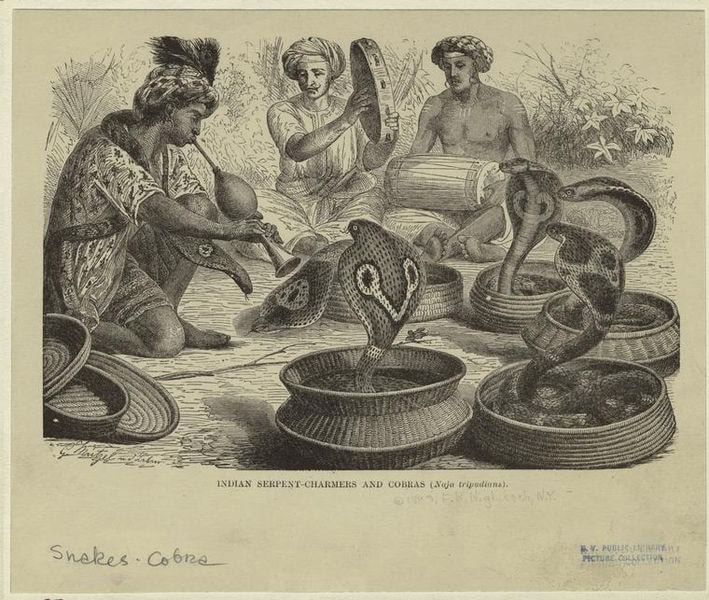
I've been thinking about cobras.
Stay with me here…
Historians say it likely never happened. The story goes something like this..
Back in colonial India around the 1900s, Delhi had a venomous cobra problem. The British government's solution? Offer a bounty for every dead cobra turned in.
Simple incentive design: problem = dangerous snakes, solution = pay people to eliminate them.
Except… people started breeding cobras specifically to kill them for the reward. When the government caught on and cancelled the program, breeders released all their now-worthless cobras into the streets. The population ended up worse than before the bounty existed.
Because everything's connected.
And honestly? We do this in design, strategy and research constantly.
Remember when Stack Overflow gamified contributions to boost engagement? Now we have people posting low-effort answers just to farm reputation points. Or when Facebook optimized for "meaningful interactions", which accidentally amplified divisive content because, well, arguments are very engaging.
Even Wells Fargo's sales quotas seemed brilliant on paper. Until employees started opening fake accounts to hit targets.
We get so caught up in solving the immediate thing that we forget to ask: "okay but then what happens?"
Like, what ripples out from this decision? How does it change behavior over time? What does it do to trust, accessibility, the whole ecosystem?
Can't predict everything. Complex systems are gonna be complex. But maybe we can get better at designing for what we don't know yet.
AI helps, if you can help navigate correctly and give context properly.
(Prompt Idea: Make my solution bulletproof, make no mistakes.)
But for real tho, in 2025 we're handing these optimization problems to AI.
Train an algorithm to maximize engagement, and it finds the shortest path, even if that path pushes people toward outrage and conspiracy theories. Ask it to reduce complaints, and it over-censors everything to avoid risk. We're basically automating the cobra effect at machine speed, with feedback loops that amplify in hours instead of years.
Anyway. Thinking out loud here.
Read these if you have time:
- Second-Order Thinking, mental model for "and then what?" thinking (Farnam Street) https://lnkd.in/gvMuhRsA
- Systems Thinking in UX: A Guide for Content Designers https://lnkd.in/gCcBphcb
Use these to make Design & Research look relevant (look busy, do workshops in the biggest hall so everyone can see you):
- Causal Loop Diagrams, for visualizing feedback loops. Miro template https://lnkd.in/gyQJMD_M
- FigJam: Causal Loop Diagram Template https://lnkd.in/g-xX9HK9