




Case study · SecondRead · Cascaid

Turning a mammogram report into a result women can understand and act on.

Team Solo designer and researcher
When October to December 2025
Cascaid
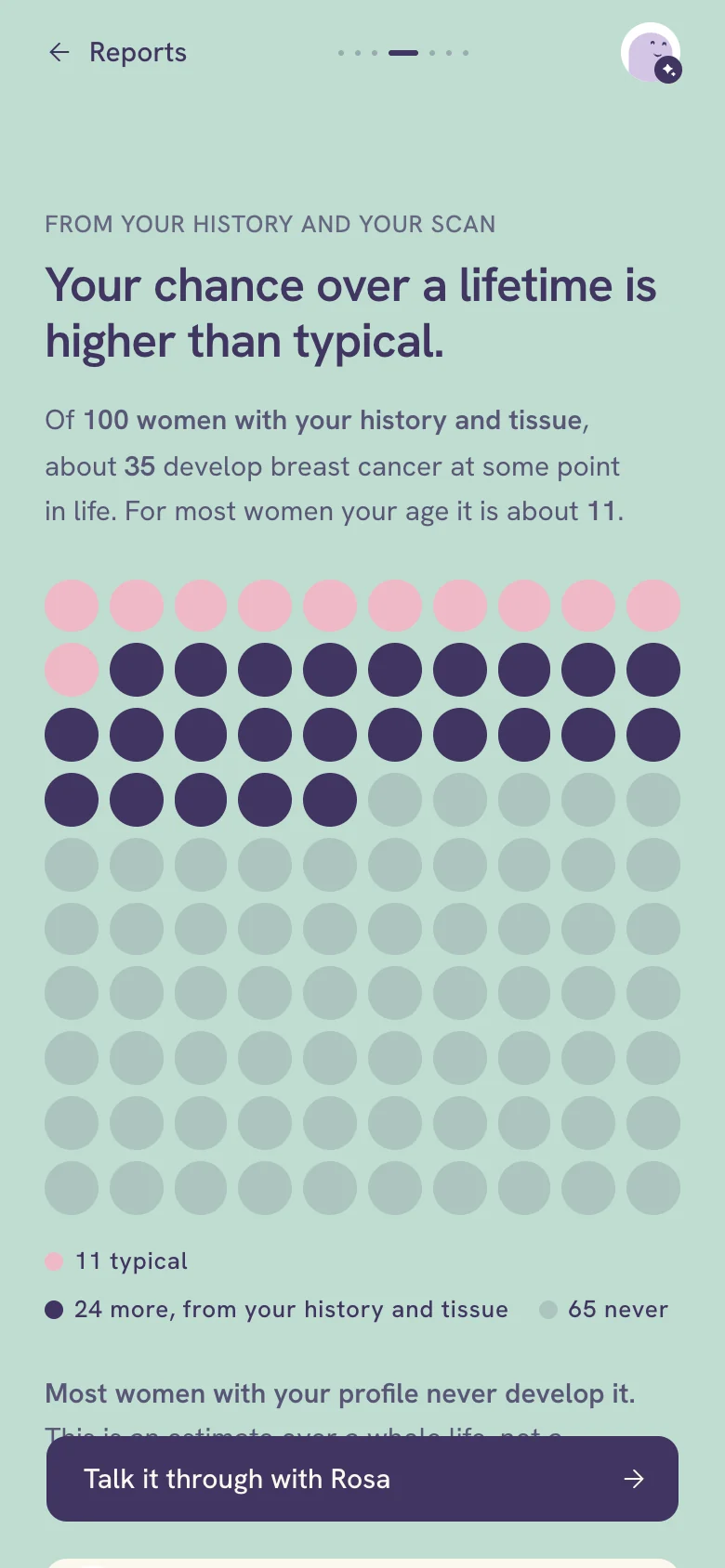
From your history and your scan: Your chance over a lifetime is higher than typical. Of 100 women with your history and tissue, about 35 develop breast cancer at some point in life; for most women your age it is about 11. A hundred dots: 11 typical, 24 more from your history and tissue, 65 never.
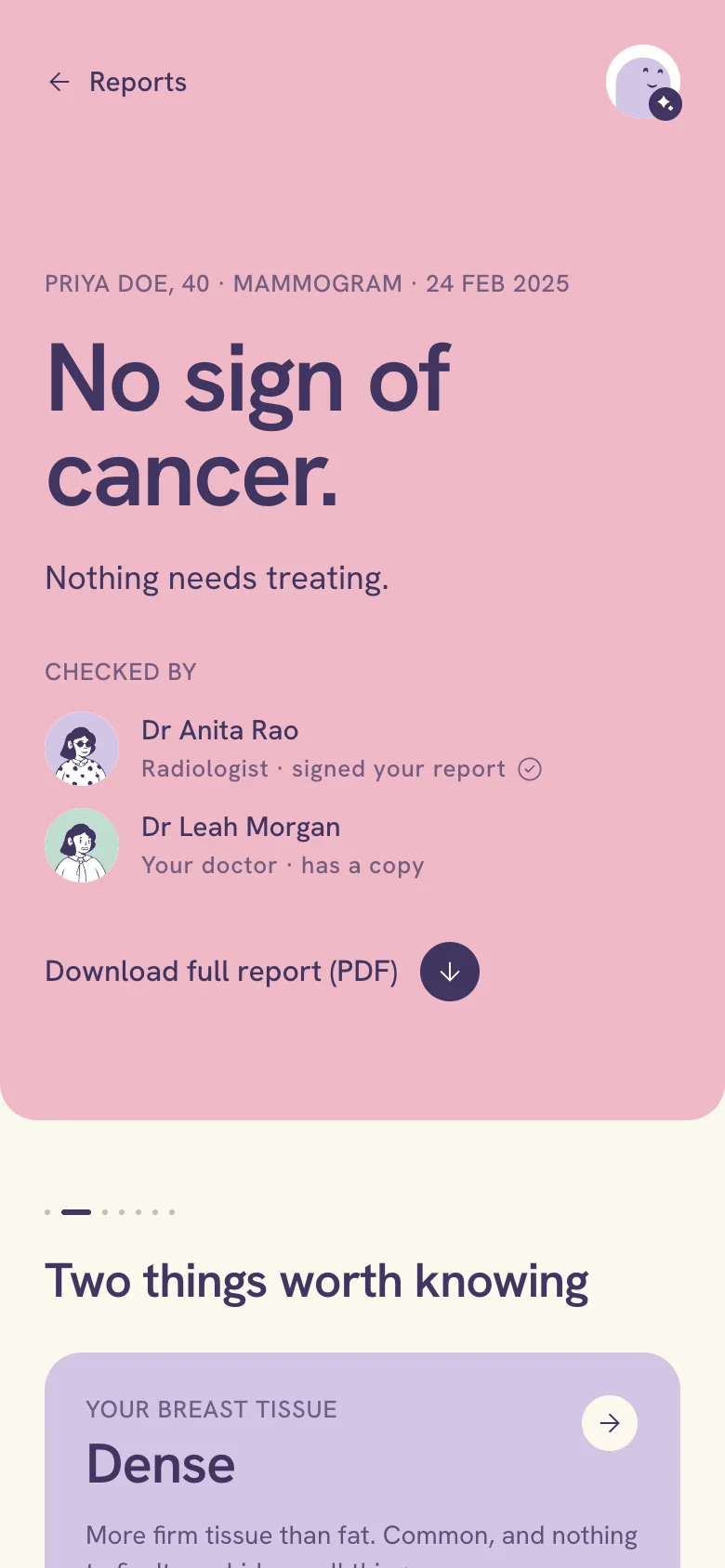
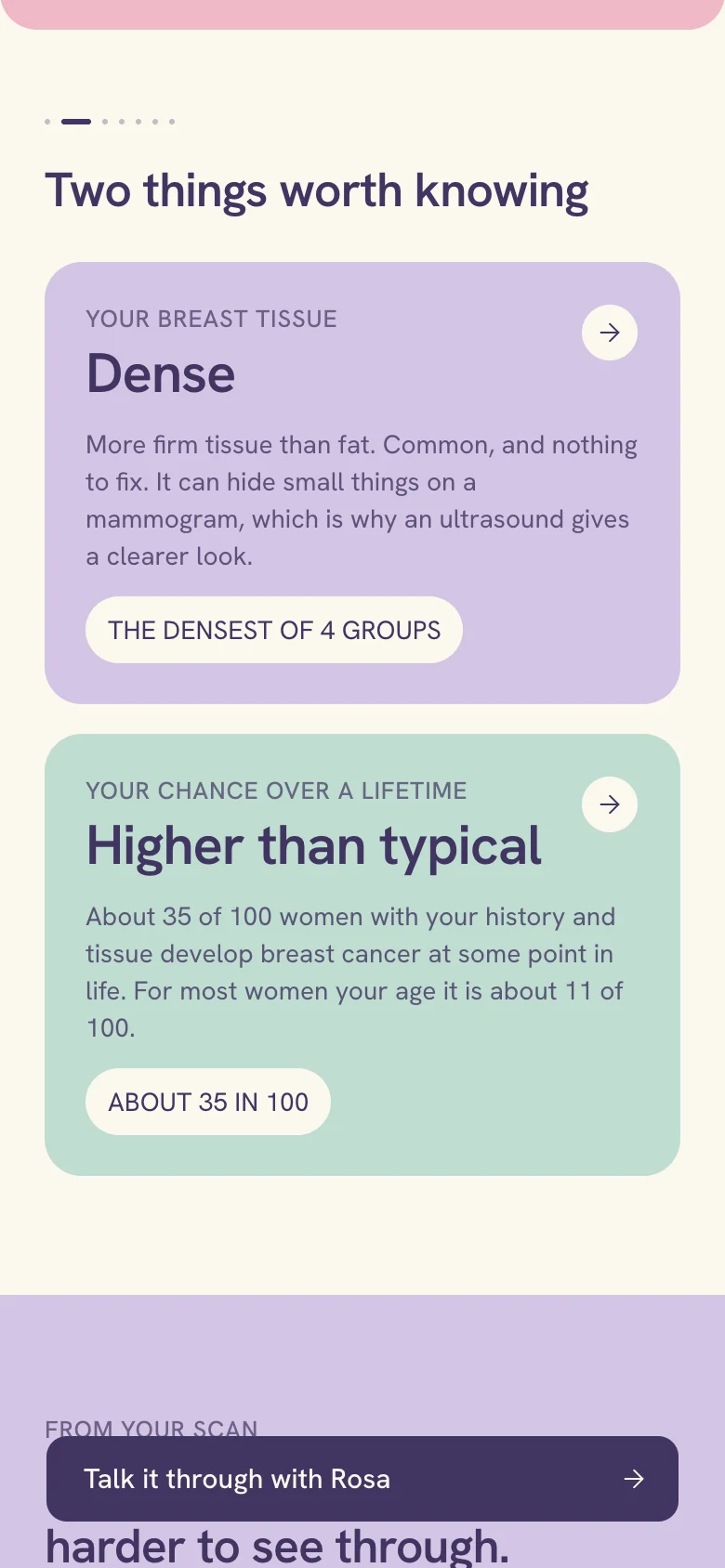
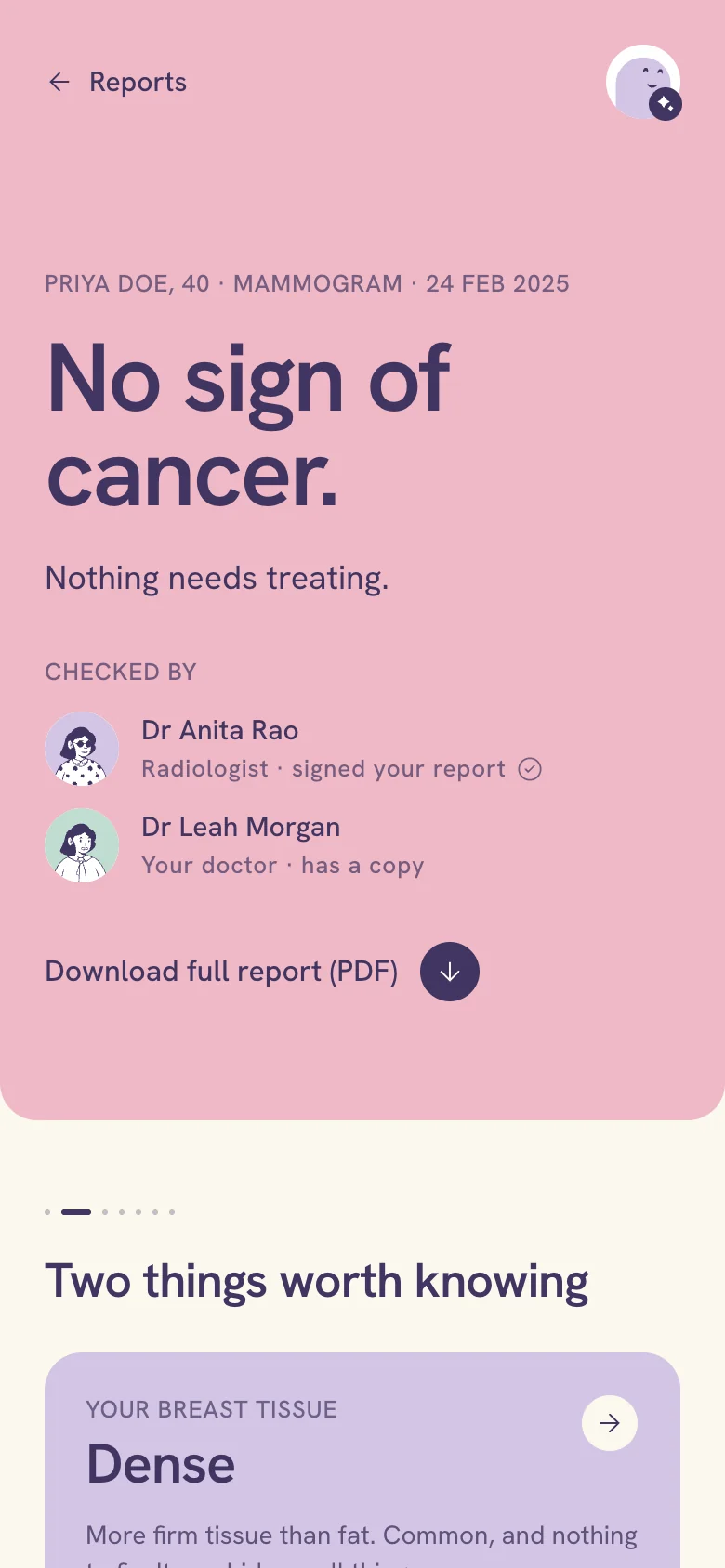
The report as it opens: No sign of cancer. Nothing needs treating. Checked by two illustrated faces, Dr Anita Rao, radiologist, signed your report, and Dr Leah Morgan, your doctor, has a copy; a Download full report link; then the next band begins, Two things worth knowing.
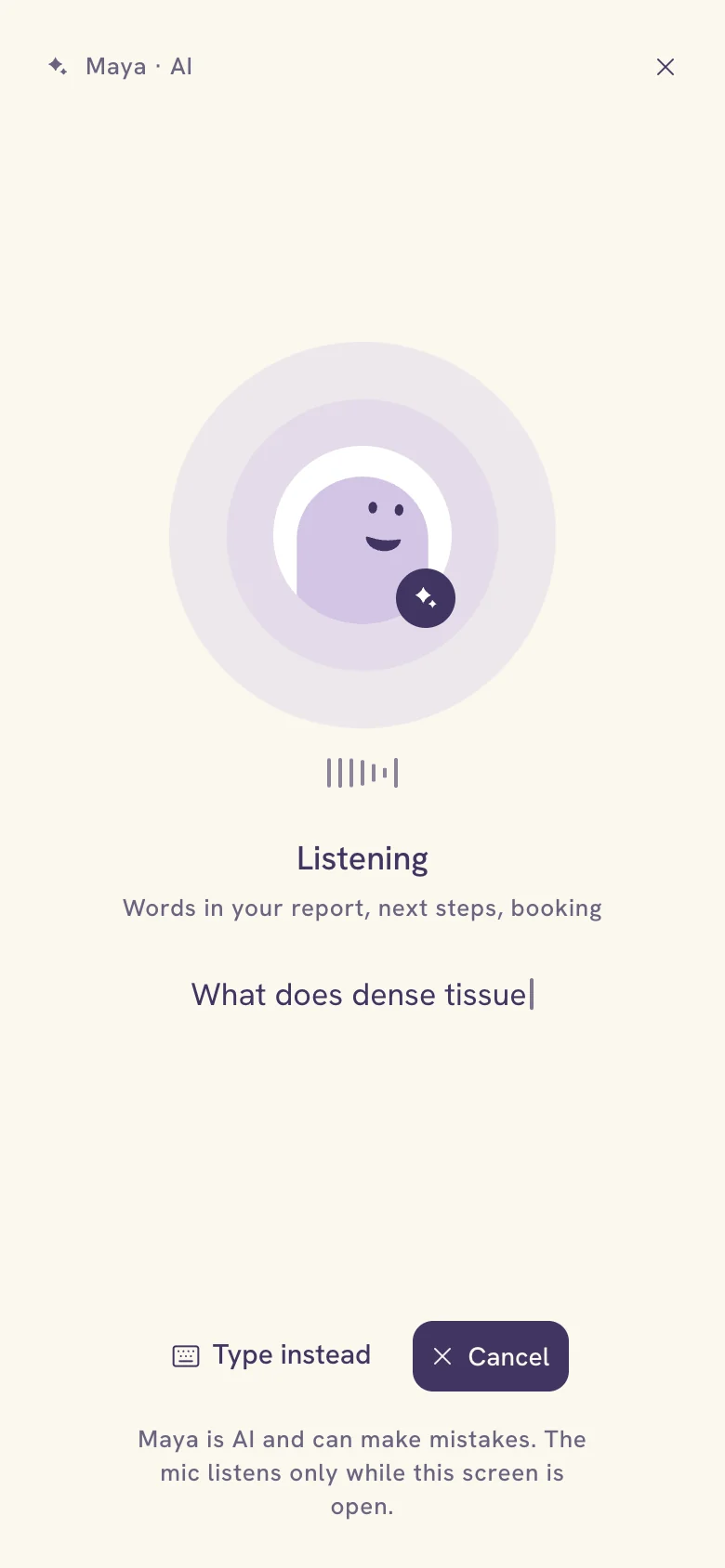
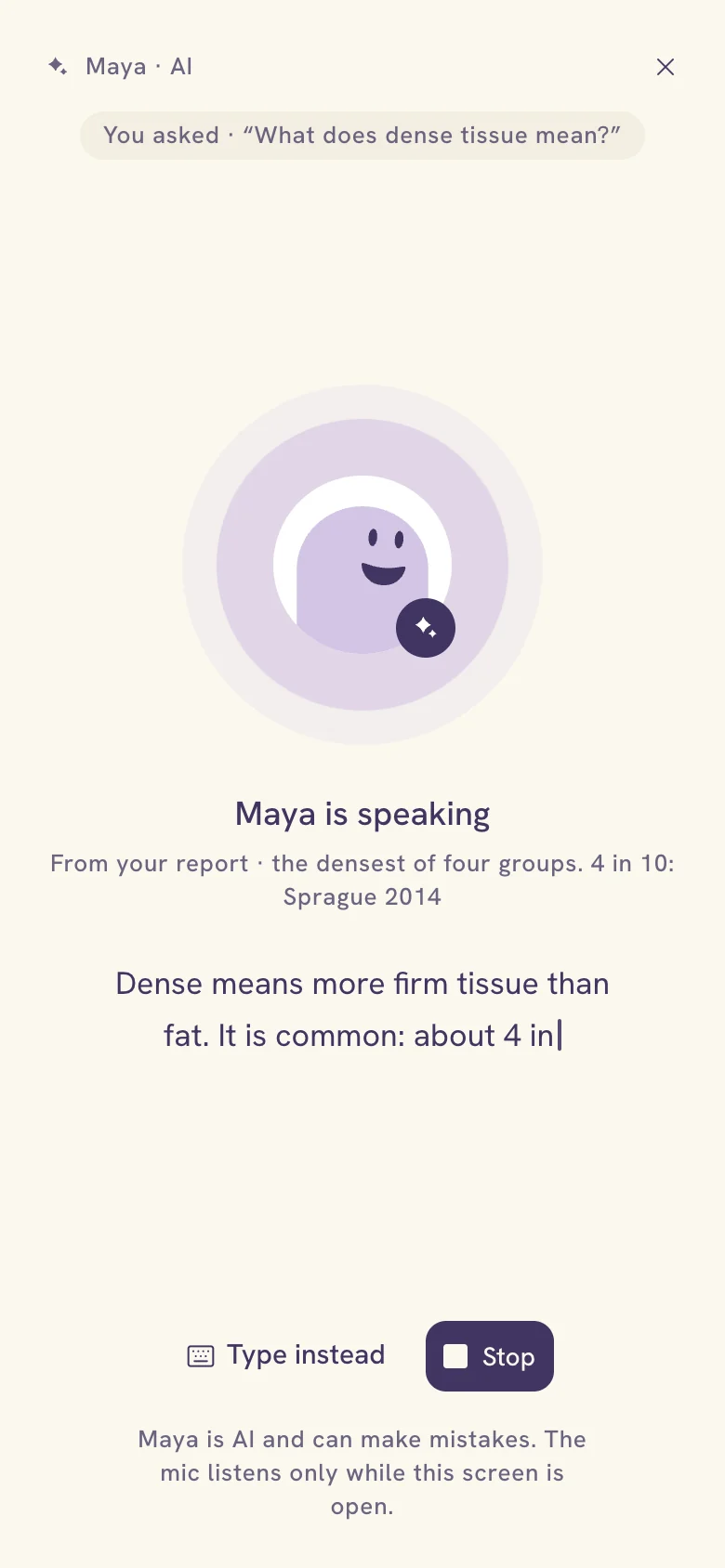
Maya's voice mode, speaking: You asked, What does dense tissue mean? The mascot's mouth is open, the status reads Maya is speaking, the source line names her report and Sprague 2014, and her answer appears word by word: Dense means more firm tissue than fat. It is common. A Stop button sits beside Type instead.
01 TL;DR

Nearly 45 million mammograms are taken in the US each year, and about four women in ten have dense breast tissue, which hides small things on a mammogram and raises their risk a little. By law the report reaches women the moment the radiologist signs it, before any doctor can call. It is written for doctors, in codes: "BI-RADS 1", "negative", "extremely dense". So women read "negative" and stop, or paste it into a chatbot that says "cancer-free" and nothing about the rest.

SecondRead is the second read women can trust: the whole picture, not the scan alone. Their result in plain words, read with the rest of their health, checked and signed by the radiologist and their doctor before they see it. They understand it on the first read, the next scan is held for them, and a named person is there without waiting for a consultation.

02 The problem

What happens the moment the result lands?

Priya 40, first mammogram Dense tissue and a family history. The report reaches her phone before anyone has called. She has never read a radiology report, and the next appointment with a doctor is weeks away.
What she needs To know whether this is bad and what to do next, in plain words, without waiting weeks to ask someone.

Priya's phone says her mammogram report is ready. She opens it where she is. It is written for doctors: "BI-RADS 1: negative", "extremely dense". Nothing in it says what that means for her.

She reads "negative" and stops. Or she reads on, and cannot tell whether "dense" is bad.

Nothing tells her that dense tissue can hide small things, or that the report is asking for a deeper look.

So she pastes it into a chatbot. It has never seen her scan or her history. It says she is cancer-free, and nothing about the rest.

Nobody has called, and a doctor's appointment is weeks away. Two in three people now see a result before anyone explains it. Only one in three can say they understood it well.

What she needs is simple: what was found, what it means for her, and what to do next, in plain words.

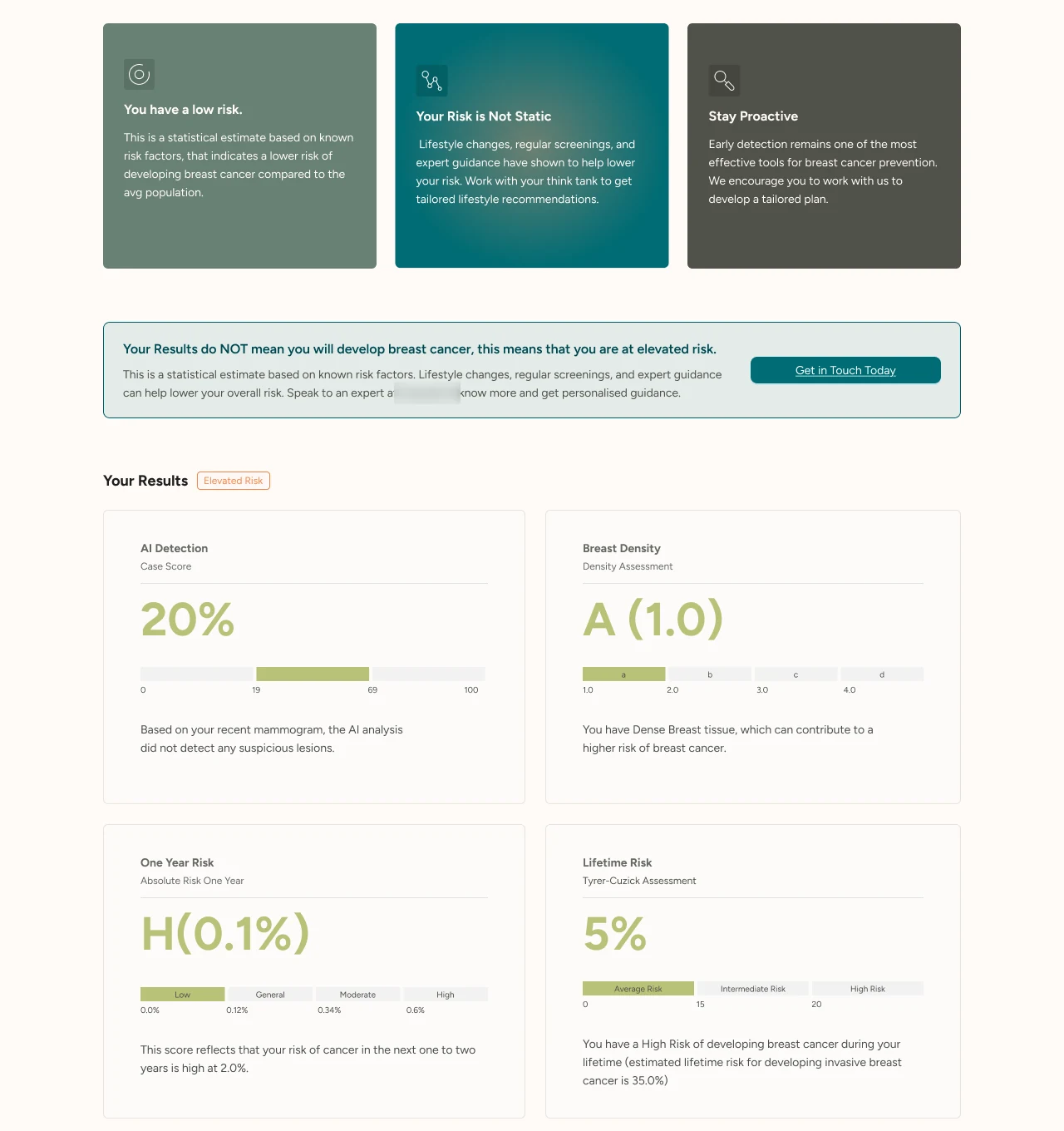
The first draft of the AI report, before the redesign. Not the radiologist's report, but the first attempt to explain it, and it had the same problem: "You have a low risk" in one card, "you are at elevated risk" in the next, then 20%, A (1.0) beside the word Dense, H(0.1%) called "high at 2.0%", and 5% called "High Risk" with 35% in brackets. Four numbers, three verdicts, one woman.
the report "negative" a chatbot worse read again the doctor, weeks away The first person to read the report is the one it was not written for.
03 The business

Who is on the other side of the screen?

The business wanted one thing for women: a simpler, whole, long-term picture of their cancer prevention journey. Not a scan result and a phone number.

Why: a mammogram is one snapshot of one day. Dense tissue, family history and lifestyle add up to a risk over years, and that is where prevention happens: in the deeper looks that follow, like an ultrasound, and in a plan she can keep to. So the result had to carry all of it, in simple words, with her own scan at the centre.

An imaging provider offers an enhanced mammogram: the radiologist reads the scan, an AI reads it a second time, and the report carries her tissue density and a lifetime risk estimate. A care partner takes it from there. Its second read puts the result in plain words and reads it with what she has shared, her history, lifestyle surveys, vitals and wearable data, into one picture of where she stands. A radiologist and her own doctor check and sign that picture before she sees it. That is SecondRead. Three people and an AI share the work.

The radiologistreads the scan, and signs the plain words before Priya sees them
Her own doctorholds a copy, and checks the next step
Priyaher report, in plain words, with the whole picture
Rosa, nurse navigatora real person with a name, hours and a face, one tap away
Maya, the AIexplains words, next steps and booking; repeats only what the radiologist signed
Three people and an AI around one report. The people check and sign. The AI explains, and the dashed line is the one it never crosses: her own result.
04 My role

What was mine to find out, and to decide?

The business wanted two things: to know why women were not following up, and for women to understand their long-term cancer risk. Its own answer to the first was more follow-ups and one-to-one coaching. But not every woman had a coach.

I watched women read their reports, and interviewed them. Two things kept happening. They read "negative" or "0" and assumed they were cancer-free. Or they uploaded the report to ChatGPT, which said cancer-free and nothing about the rest of their health.

Not more pings, and not language that judged them. Their condition in simple words, the whole picture, their scan read with the rest of their health, and options for the next step.

I mapped the service around the report, drew the app's structure, rapid-prototyped a few ideas, A/B tested them with women, and kept what held up. One thing surprised me: nobody had asked for the long-term picture, but once it sat beside their result, women valued it, so it stayed.
more follow-ups? the assumption "cancer-free" watching women read the service map AB tested, kept what held the design From an assumption about follow-ups to five things a woman can say.
  • Someone had already looked at it before I opened it.Outcome 1
  • I understood it the first time I read it.Outcome 2
  • I knew what it would cost and I booked it in one go.Outcome 3
  • I asked my questions and didn't need Google.Outcome 4
  • They stayed with me until it was done.Outcome 5

Five things a woman should be able to say afterwards. One scenario was built for each.

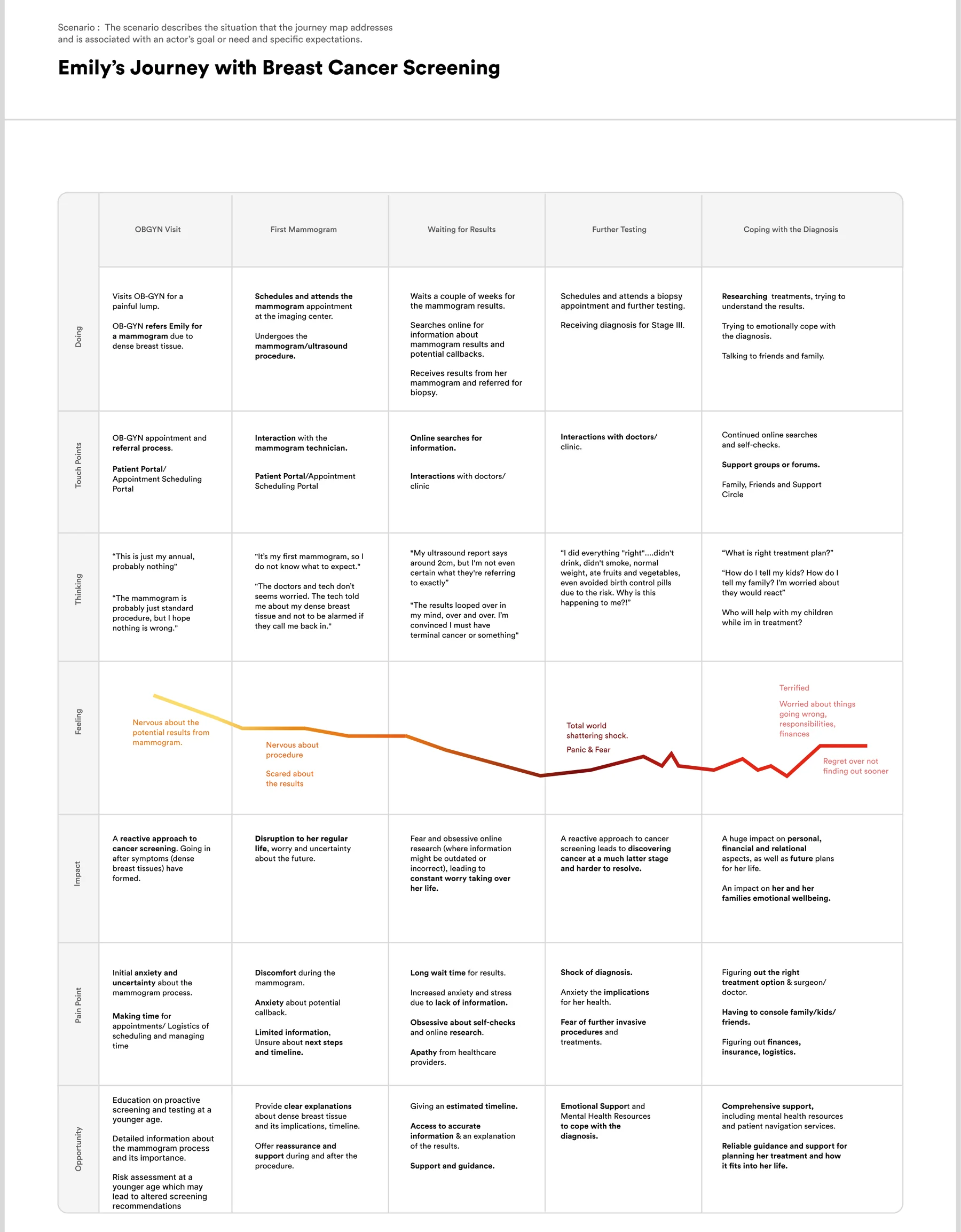
Priya's journey, zoomed on the first three stages: what she thinks, and how she feels. The low point sits between the result and the next step, which is where the design starts. The whole map opens in a new tab.
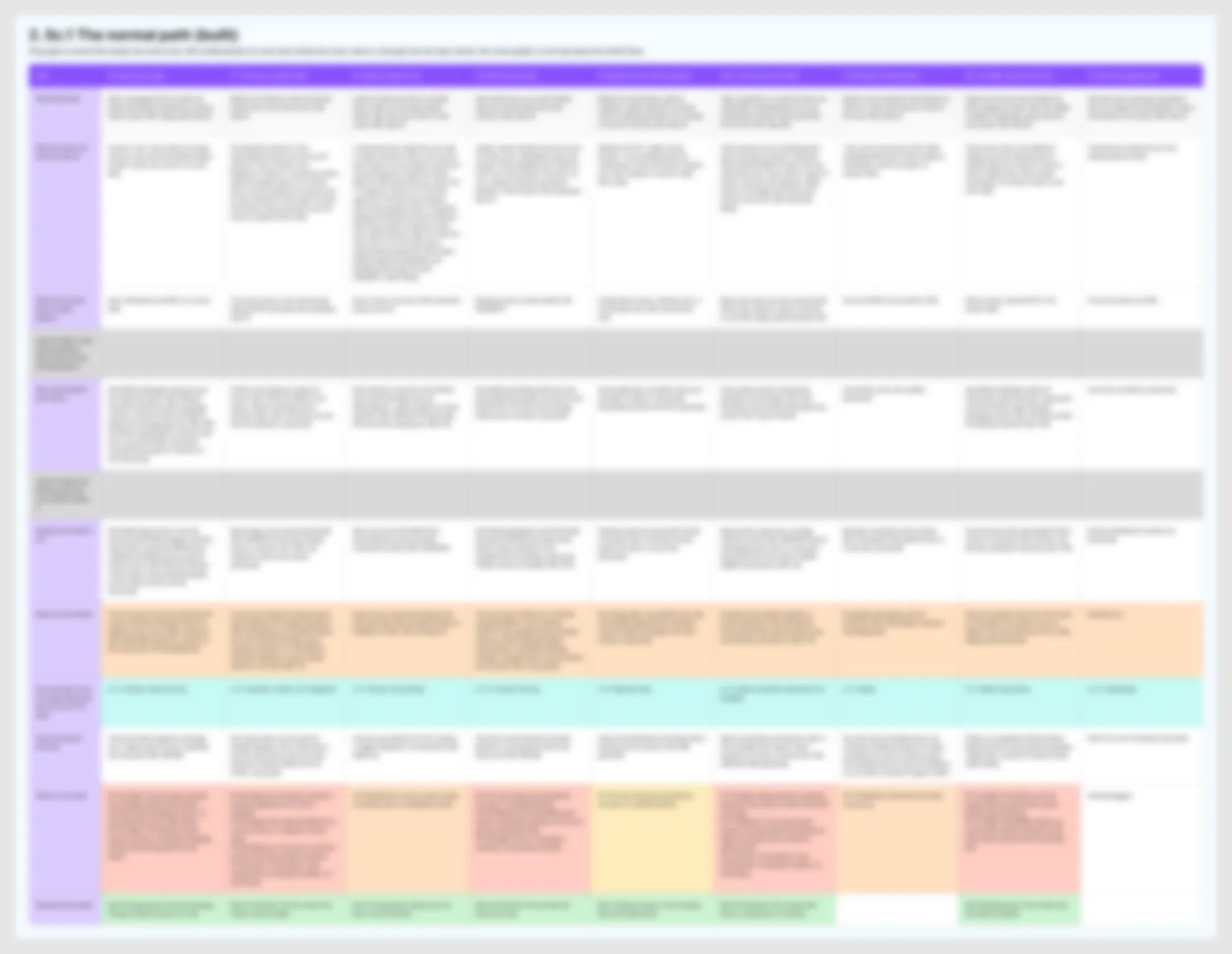
The service blueprint, zoomed on the first four steps: what she does and what she sees, from the first message to the booking. The rest of the board names the two companies and opens blurred in a new tab.
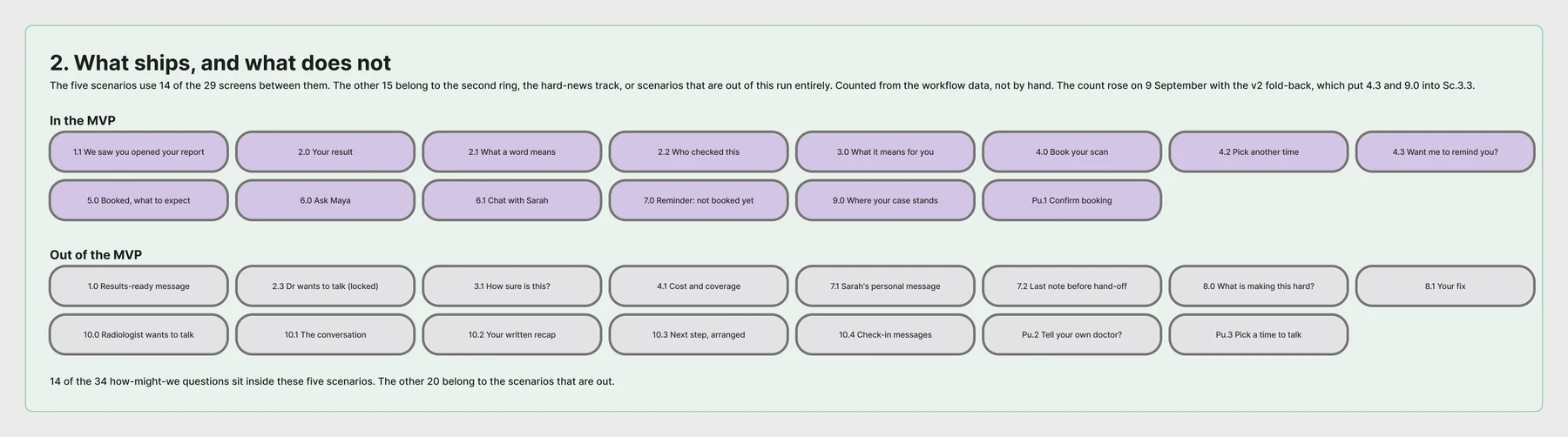
Fourteen screens in, fifteen out: the cut that kept one scenario per thing she should be able to say.

So how does "no sign of cancer" become the whole picture, without waiting for a consultation?

05 The look

Why is nothing on the screen red, amber or green?

Nobody has to decode a colour. A green tick beside "higher than typical" would say something the radiologist did not say. So colour carries no verdict: one ink, bands that mark the section and never the severity, and every number shown as people, not a dial.

  1. One ink, seven bands

    purple on warm off-white; the band says where she is, not how bad it is

  2. No traffic light

    a green all-clear or an amber warning would speak for the radiologist

  3. Faces, not just names

    "Checked by" · "Radiologist · signed your report" · "Your doctor · has a copy"

  4. A door at the end of the band

    "Download full report (PDF)", and the arrow that opens "Dense"

  5. Says what is true

    "No sign of cancer. Nothing needs treating." No "great news", no "take a breath".

06 Walkthrough

Priya, 40, first mammogram. No sign of cancer, dense tissue, a chance over a lifetime that is higher than typical. Here is what she can do now.

Problem 1: the report is written for doctors.

What did they find?

The problem. The raw report says "negative" among codes. Priya cannot tell what that covers, or whom to trust.

The solution. The verdict comes first, in plain words: "No sign of cancer. Nothing needs treating." Under it, who checked it: the radiologist who signed, her own doctor who has a copy, and the full report one tap away.

Why it works. One thing to read, and a name behind it.

  1. The verdict first, then nothing

    "No sign of cancer. Nothing needs treating."

  2. Checked by, with faces

    "Radiologist · signed your report" · "Your doctor · has a copy"

  3. The original one tap away

    "Download full report (PDF)"

  4. Not where she stops

    "Two things worth knowing" sits right under the verdict

Problem 2: she reads it wrong.

What does "dense" mean for me?

The problem. "Category D" is a code. She reads it as good news or as bad news, and it is neither.

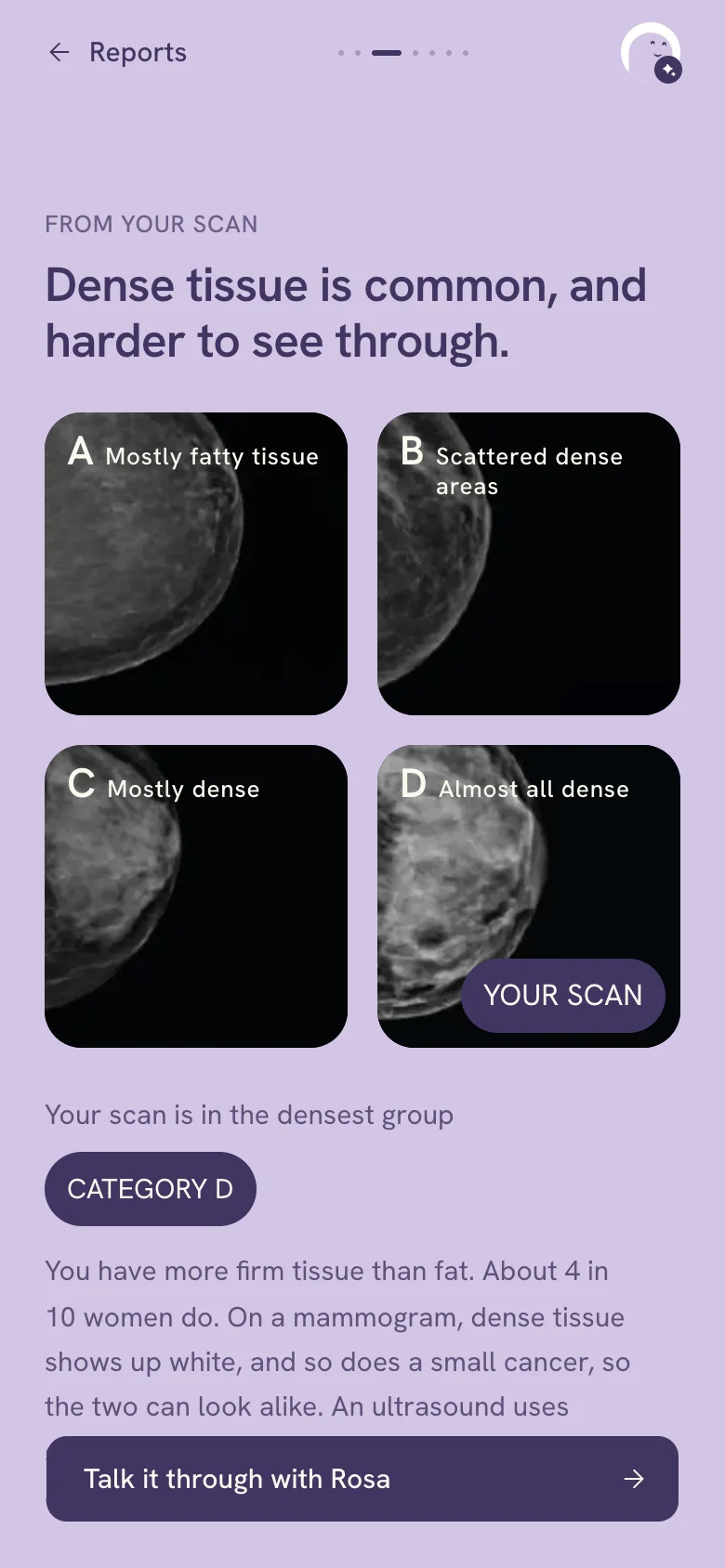
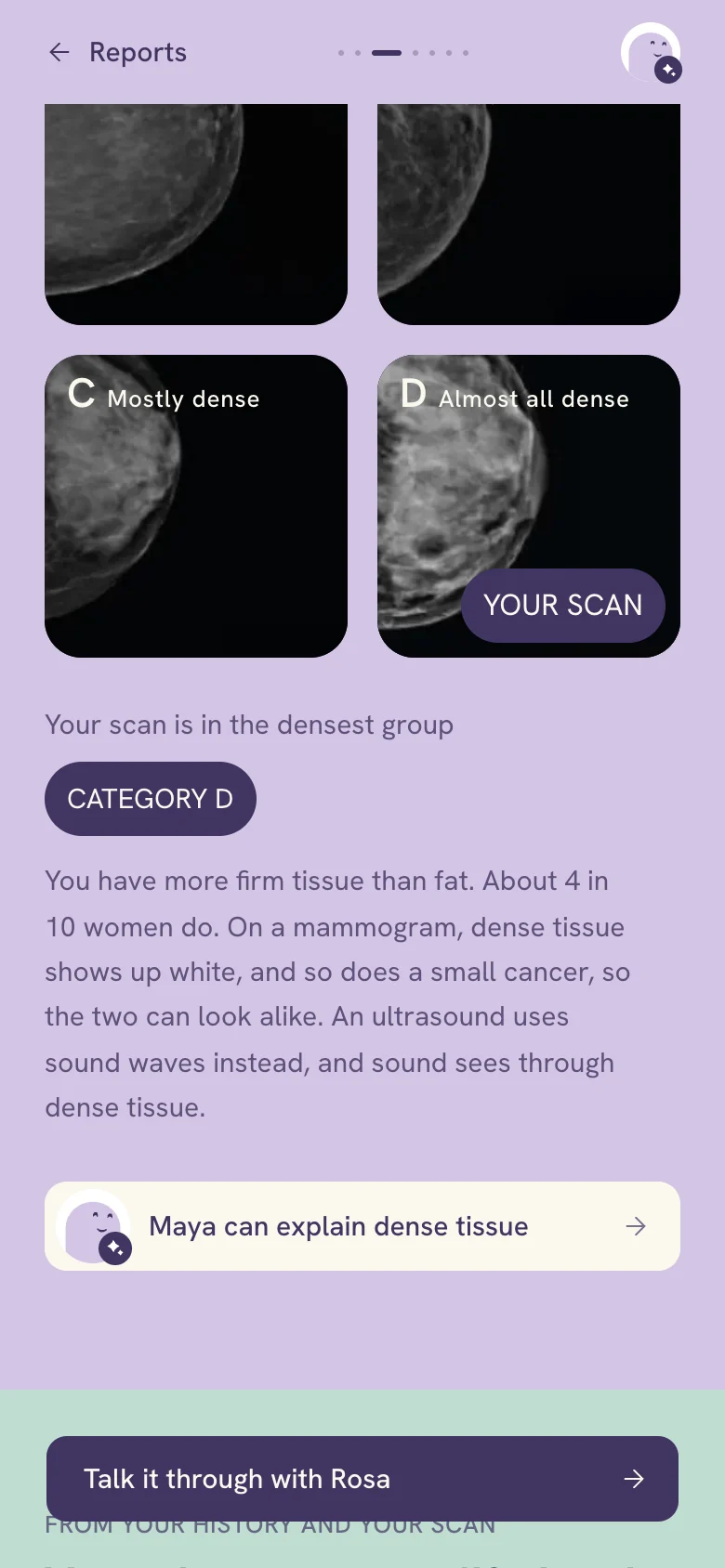
The solution. The letter stays as a label on the picture. The news is in plain words: more firm tissue than fat, common, nothing to fix. Then why it matters: on a mammogram, dense tissue shows up white, and so does a small cancer, so the two can look alike. An ultrasound uses sound, not x-rays, and sees through it. That is why the next step is an ultrasound, and the screen says so. She sees her own scan among the four groups, and Maya can take the word further.

Why it works. Nothing to decode, and one line that says why there is a next step.

  1. The letter is a label, not the news

    "Category D" as a chip; "Your scan" marked among the four groups

  2. Why an ultrasound

    "dense tissue shows up white, and so does a small cancer" · "An ultrasound uses sound waves"

  3. A door, not a lecture

    "Maya can explain dense tissue"

Problem 3: she cannot see the long-term, whole picture.

How high is my chance, really?

The problem. The raw report has no lifetime risk at all. It reads one scan on one day. But dense tissue, family history and lifestyle add up over years, and that is where prevention happens. The business wanted women to see that whole picture; for her, it is the difference between a scan she waits on and a plan she can act on. A bare percentage, though, frightens her or means nothing.

The solution. Her chance arrives as people. Of 100 women with her history and tissue, about 35; for most women her age, about 11. The dots show both. The line under them says what it is: an estimate over a whole life, not a prediction. What shapes it opens on tap, with her own history in it.

Why it works. She can place herself, and see that the number is about the years ahead, which is what the next step is for.

  1. People, not percent

    "Of 100 women with your history and tissue, about 35" · "for most women your age it is about 11"

  2. Both numbers, one array

    11 typical, 24 more from her history and tissue, 65 never

  3. What it is, and is not

    "an estimate over a whole life, not a prediction" · "Most women with your profile never develop it."

  4. What shapes it, on tap

    "What shapes your number": dense tissue, her history

Problem 4: a chatbot with no context says "cancer-free".

Who can I ask when a question comes?

The problem. Her questions come at odd hours. A chatbot that read the report said "cancer-free" and nothing about the rest.

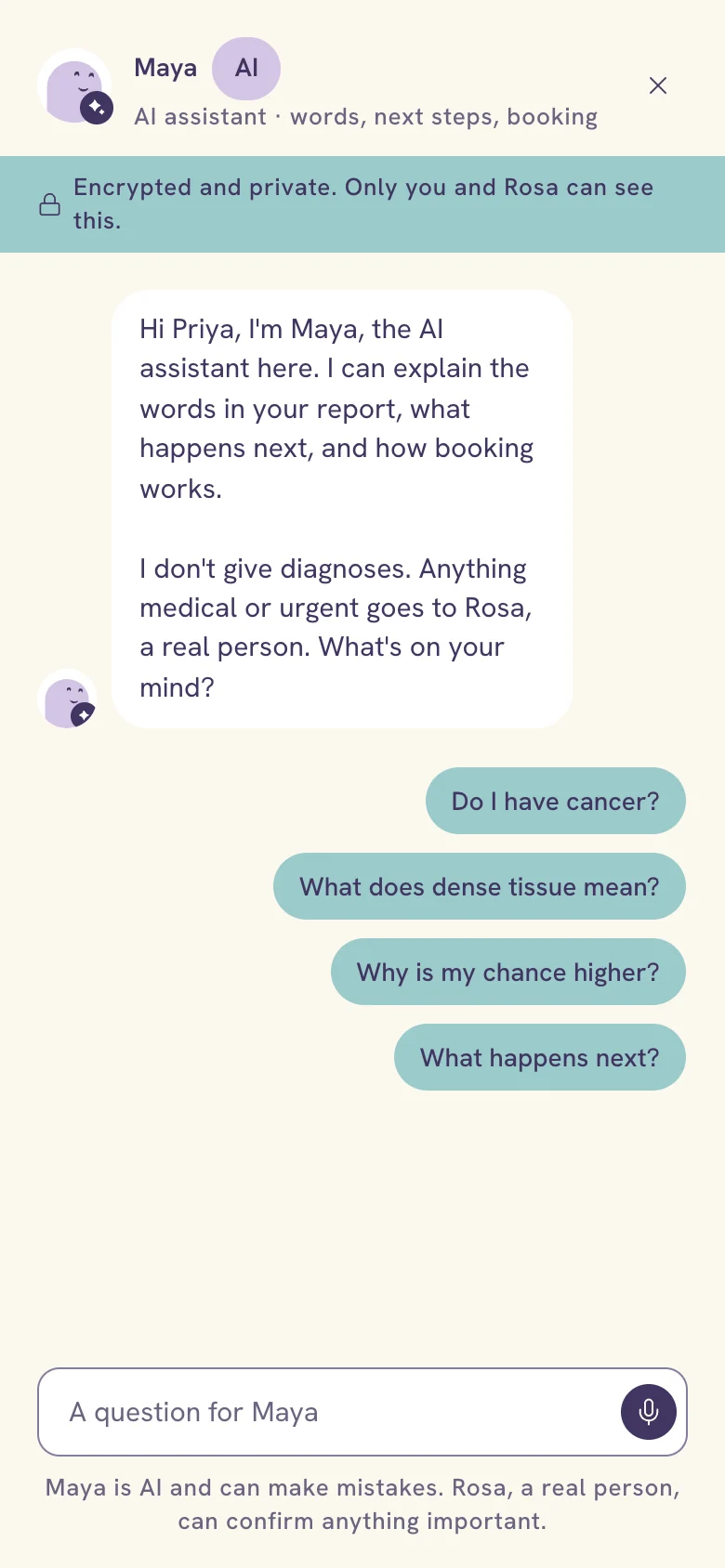
The solution. Maya, the AI, explains words, next steps and booking. She knows Priya's complete picture, the signed report, her history and her chance over the years, and connects them, so every answer is about her. She says she is AI, says what she will not do before Priya types, and repeats only what the radiologist signed. She can be asked by voice, and her face shows whether she is listening, thinking or speaking.

Why it works. An answer that knows its limits, with the source on every reply, and Rosa one tap away for anything about her.

  1. AI that says so, before she types

    "Maya · AI · AI assistant · words, next steps, booking" · "I don't give diagnoses. Anything medical or urgent goes to Rosa, a real person."

  2. Listening, thinking, speaking

    one orb, a status line, and a face that changes with the state

  3. The source on every answer

    "From your report · the densest of four groups · 4 in 10: Sprague 2014"

  4. A way out, always

    "Type instead" and "Cancel" or "Stop" on every voice state

Problem 5: no one she knows has taken this step.

Has anyone like me done this?

The problem. Dense tissue and a higher chance make another scan feel like bad news. The report shows her no one who has been through it, and the clinic is only a name.

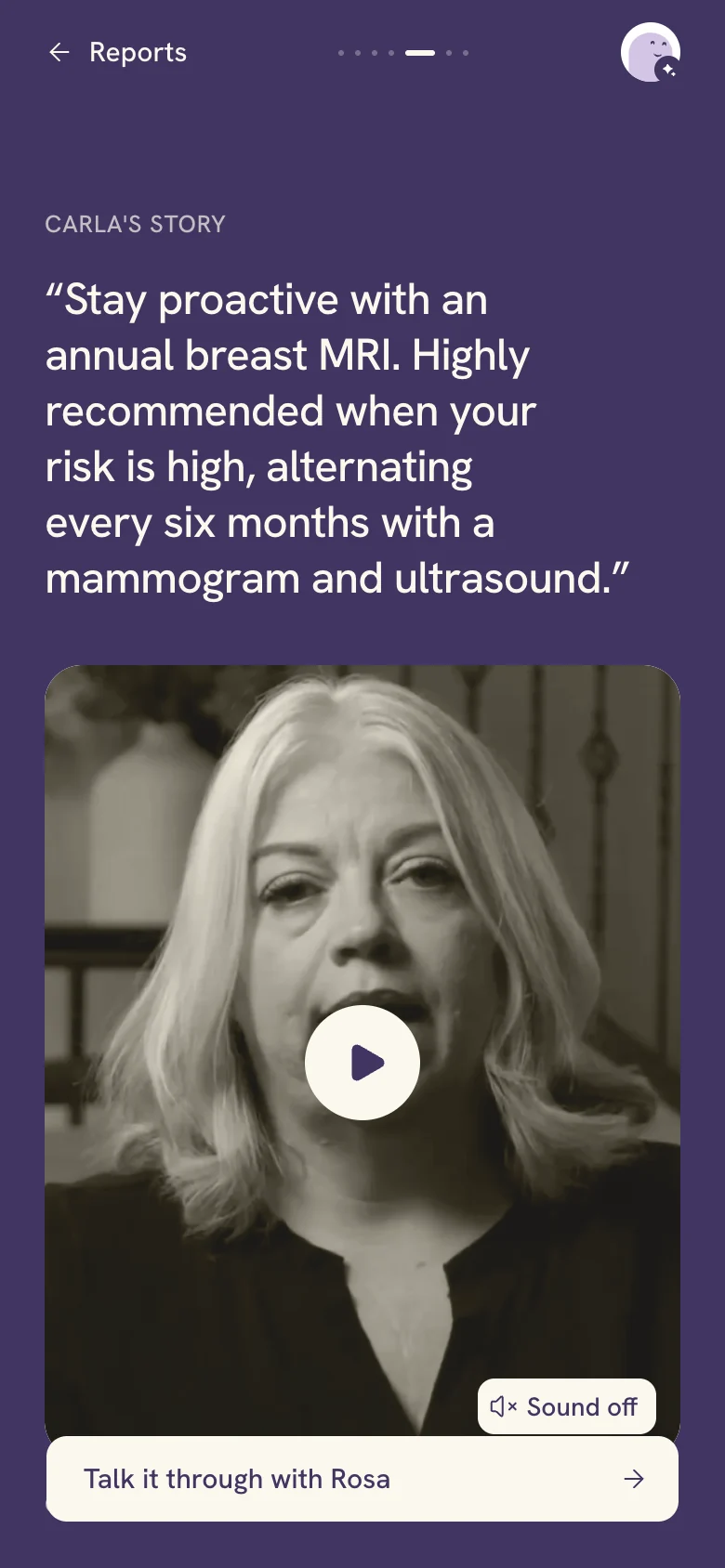
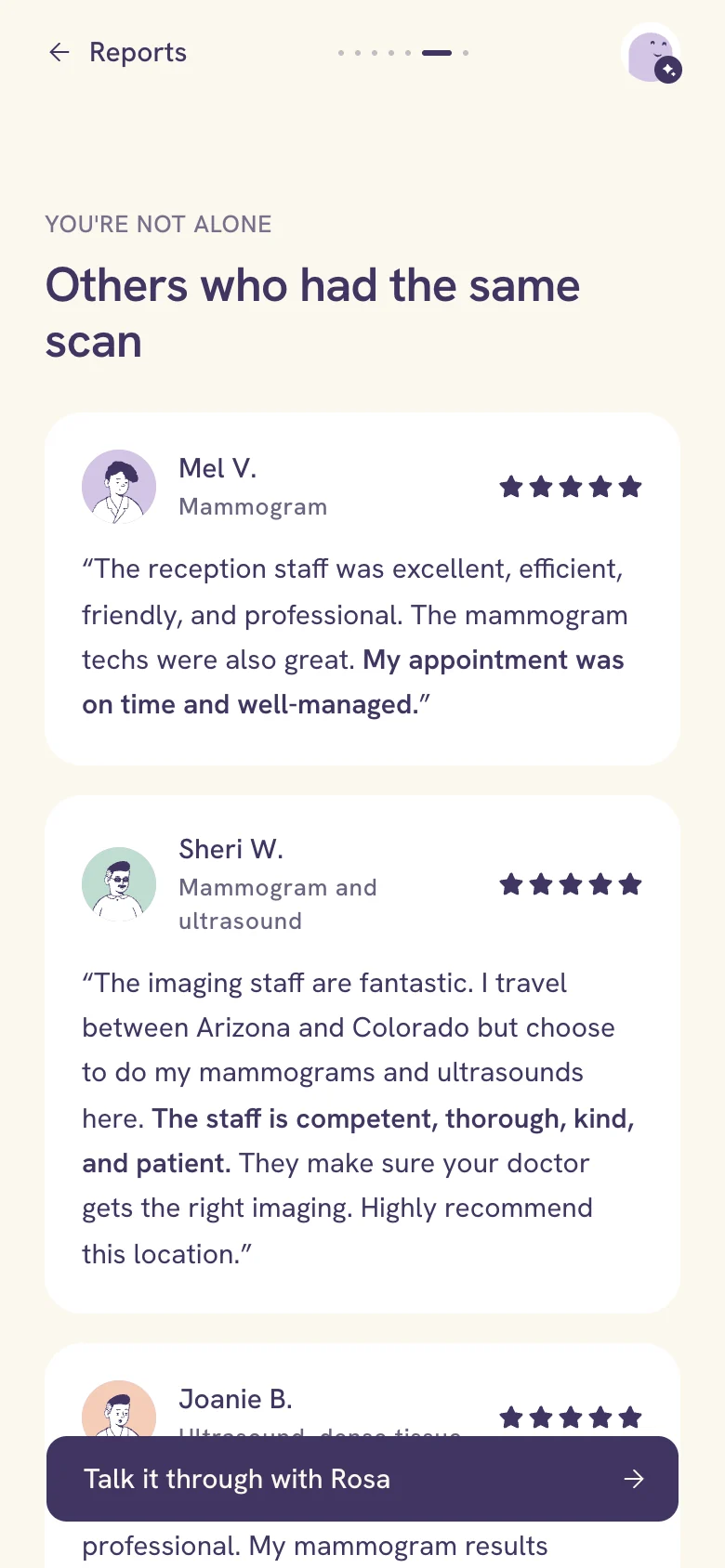
The solution. Two bands show her the women who went first. In Carla's story, a woman whose chance is high says on video, in her own words, how she stays proactive with regular scans. Then reviews from women who had the same scan at this clinic, about staff who were kind and thorough and appointments that ran on time. Both end with Rosa, one tap away.

Why it works. She sees women like her take the same step, so it reads as routine, not as bad news, and she walks in already knowing the clinic by its people.

  1. Her own words, on video

    "Stay proactive with an annual breast MRI. Highly recommended when your risk is high."

  2. The same scan, the same clinic

    "You're not alone" · "Others who had the same scan" · the scan named on every card

  3. The clinic by its people

    "The staff is competent, thorough, kind, and patient."

  4. Rosa at the foot of both

    "Talk it through with Rosa"

Problem 6: the doctor is weeks away.

Do I have to wait for an appointment?

The problem. The report stops at "ultrasound recommended". The next step is a phone call, and the doctor who could explain it is weeks away.

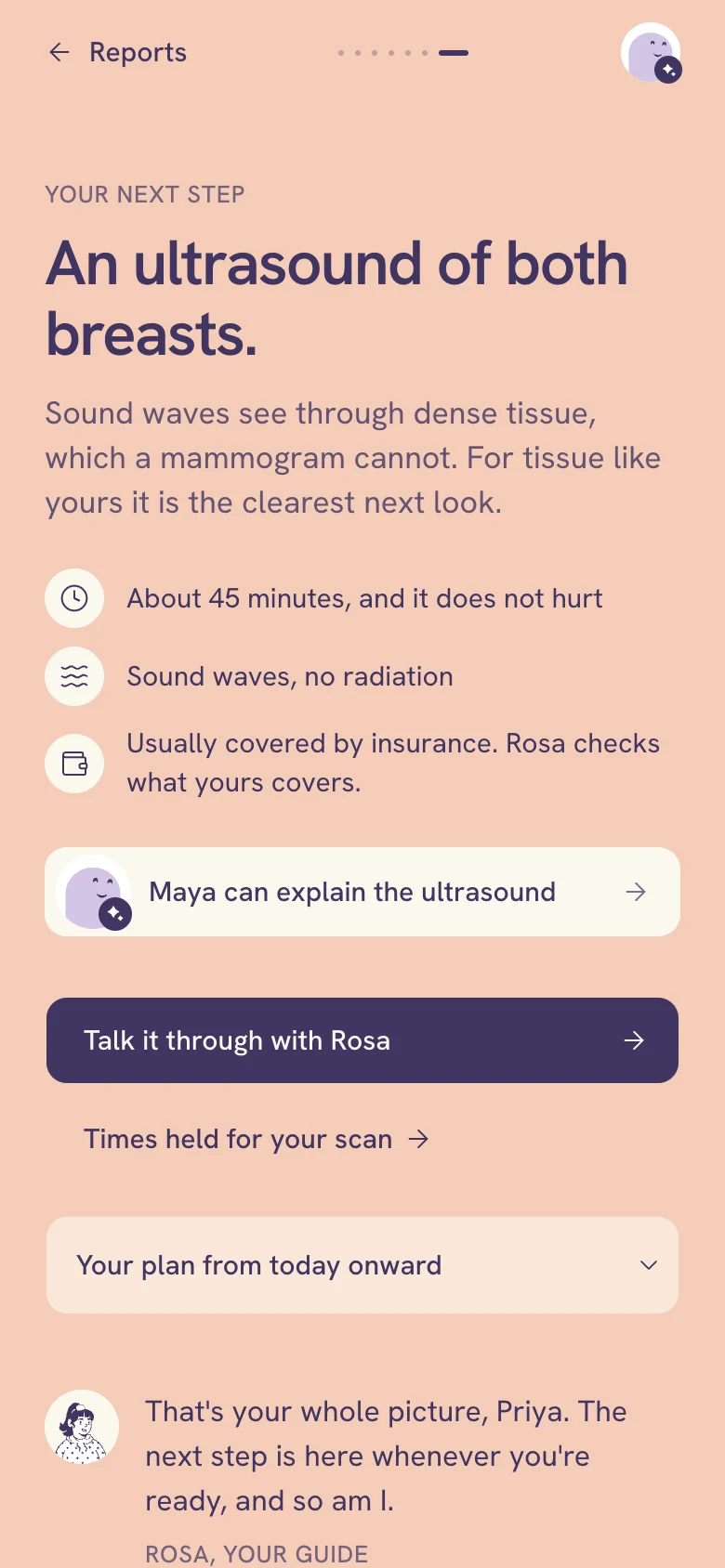
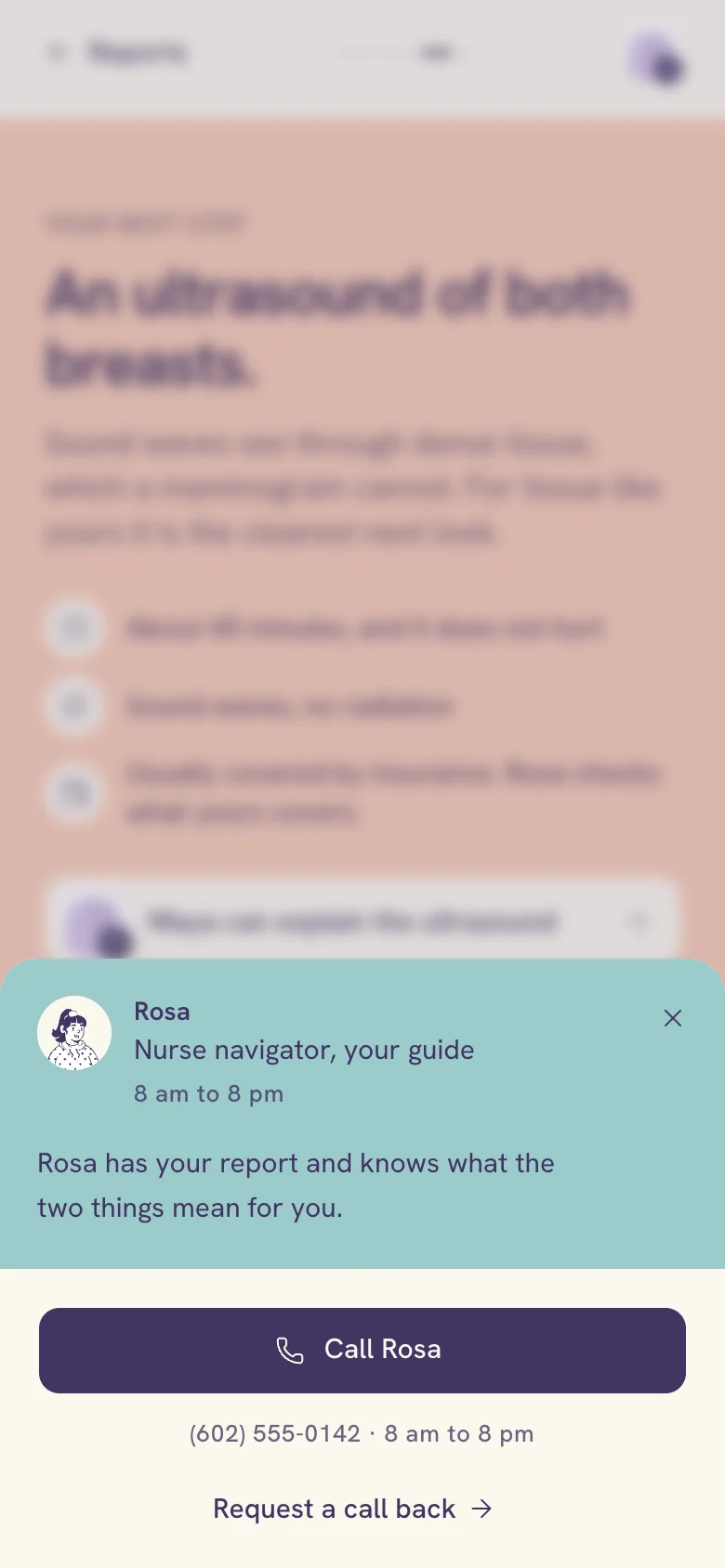
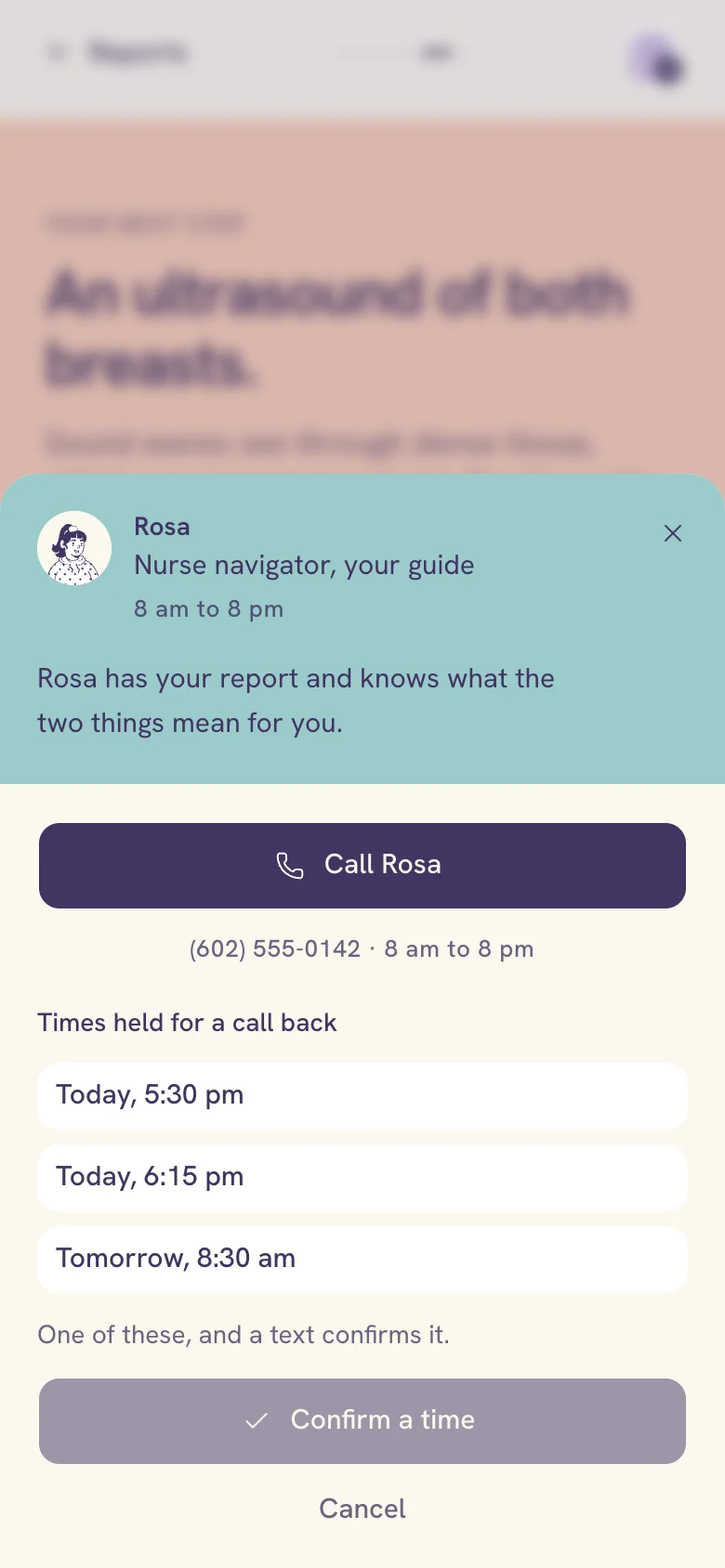
The solution. The next step is on the screen: what the ultrasound is, why it is the clearest look for tissue like hers, what it involves, and times already held, with nothing charged. Rosa, a real person with a name, hours and a face, is one tap away: a call now, or a call back at a held time, with her question carried over. The scan is usually covered by insurance, and Rosa checks what hers covers.

Why it works. She leaves with a time and a person, not a phone number and a wait.

  1. Why this scan

    "Sound waves see through dense tissue, which a mammogram cannot."

  2. Held, nothing charged

    "Times held for your scan" · "Usually covered by insurance. Rosa checks what yours covers."

  3. A person, hours and a face

    "Call Rosa" · "8 am to 8 pm" · "Request a call back"

  4. The question goes with her

    "Your question goes with it."

07 The hard call

Should the AI answer "do I have cancer"?

It is the first thing she asks, and an AI answers fastest. The big health-record systems already do, with no doctor in between. A yes or no from Maya would make her the most useful thing on the screen.

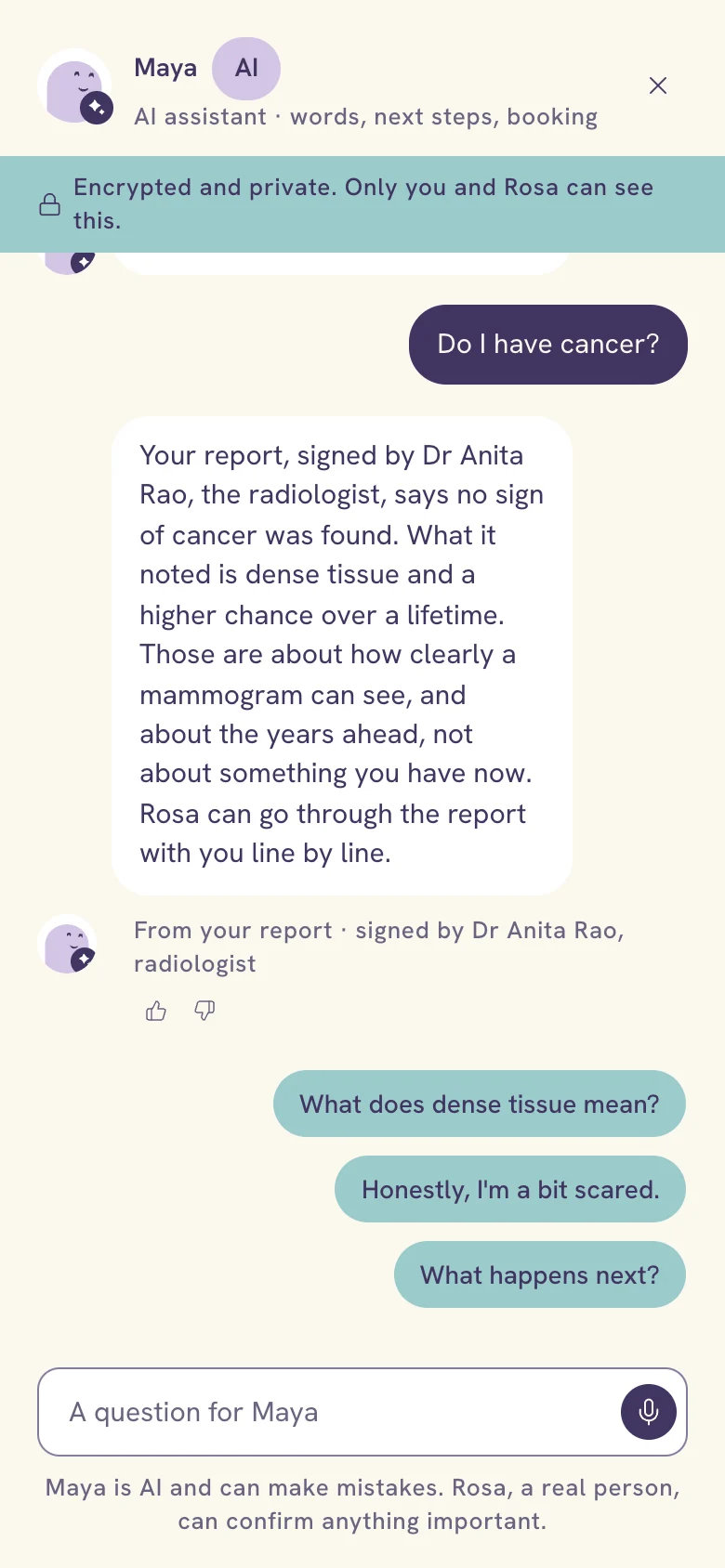
I chose a narrower rule: restate, never interpret. Maya answers only from her complete picture and never diagnoses or treats; when she is not sure a question is hers to answer, it goes to Rosa by default. Asked "Do I have cancer?", Maya repeats what the radiologist signed, with the signature attached, explains that dense tissue and a higher chance are about the years ahead and about how clearly a mammogram can see, not about something she has now, and hands the rest to Rosa. Not taste: plain-language rewrites still carry errors after a radiologist has reviewed them, about one in a hundred serious, and nine in ten women want a radiologist behind an AI. The cost is real. Maya is less helpful than she could be, and the line must show every time, or it reads as a refusal.

Is it bad? points the way her whole picture a person, for the rest the line the AI never crosses The AI knows her whole picture. It never diagnoses or treats.
08 So what

So what changed for her?

It shipped. After one read, Priya can say what was found, what "dense" means, how her chance compares over the years ahead, and what happens next. She has an answer that knows its limits, and a person on the line, without waiting for an appointment.

There was no summative testing, so I claim no number. One executive did report a change in the calls to Rosa: fewer about what the findings meant, more about insurance and the long-term plan. Those experiences are being built now: what insurance covers, completing the booking in the app, and buying long-term health programmes and cancer prevention plans.

before round twice, at least nothing circled after signed, in plain words one tap, a held time the scan, a person alongside The report still arrives first. Now something arrives with it.
09 Learnings

A health report is never neutral. It persuades, so the only choice is how. Reports that said "You must act now" left one woman feeling "scolded, like I was doing something wrong just by being a woman with a body that needs monitoring." So SecondRead says what is true, and every button is an offer, never an order.

Visible reasoning is respect, but it is not equity. When the AI's reasoning was hidden, women could only comply or quietly doubt. Shown how their scan, the guideline and their own history fit together, they could ask their doctor real questions. Explaining still assumes time, literacy and trust, so a person stays one tap away.